Seeing Measurement
Introduction
Matjiesfontein in the
|
Atmospheric turbulence Atmospheric
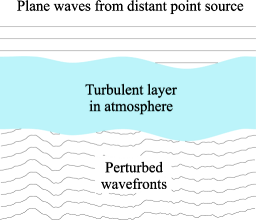
turbulence results in perturbations of the electromagnetic wave fronts
emanating from extra-planetary sources. These perturbations cause starlight to
undergo refraction, absorption, dispersion, blurring etc. Atmospheric
turbulence thus causes stellar images to spread out and jump around when viewed
through a telescope. From this change in image relative to that expected under
perfect conditions, we can derive a measure of the seeing quality.
|
Schematic diagram illustrating how optical wavefronts from a distant star may be perturbed by a turbulent layer in the atmosphere. The vertical scale of the wavefronts plotted is highly exaggerated. Taken from Bob Tubbs' thesis (http://www.mrao.cam.ac.uk/telescopes/coast/theses/rnt/node4.html) |
Automated seeing monitor
system
The
proposed system is to consist of a telescope, CCD camera and control/processing
PC. The procedure involves observing of stars at various hour angles and
declinations on the night sky and capturing frames of varying exposure times
throughout the night. Close binaries will also have to be observed for calibration
and verification purposes. Statistical analysis of the captured images will be
compared with the theoretical Airy function, which is a measure of an absence
of turbulence. Deviations from the Airy function will then give an indication
of seeing conditions.
Hardware and software
Data from
Antarctic seeing measurements will be processed to test the setup and procedures.
The development of the hardware and interfaces will commence hereafter, an
initial test setup being deployed at HartRAO. Data processing and analysis will
be streamlined and automated. Thereafter, Sutherland will serve as control
site, allowing for comparison of our results with that of SALT’s
CONCAM (fisheye CONtinuous CAMera).